Measuring a Driveway Opening for a Sliding Gate in Round Rock

Why does the opening measurement decide the whole gate?

The opening decides the gate because every other number follows from it: the frame length, the tail or run beside the opening, the footing, the operator and the post spacing. A sliding gate needs about the width of the opening again as free fence line, and a cantilever needs closer to one and a half times. A measurement taken carelessly in Round Rock, TX, shows up later as a gate that will not clear a mailbox, a tree or a retaining wall.
Measuring takes a long tape, a string line, a level, a notepad and a half hour of walking the property. Nothing about it requires special tools, but it does require patience, because the numbers are taken in more than one place and compared.
How wide is the opening, really?
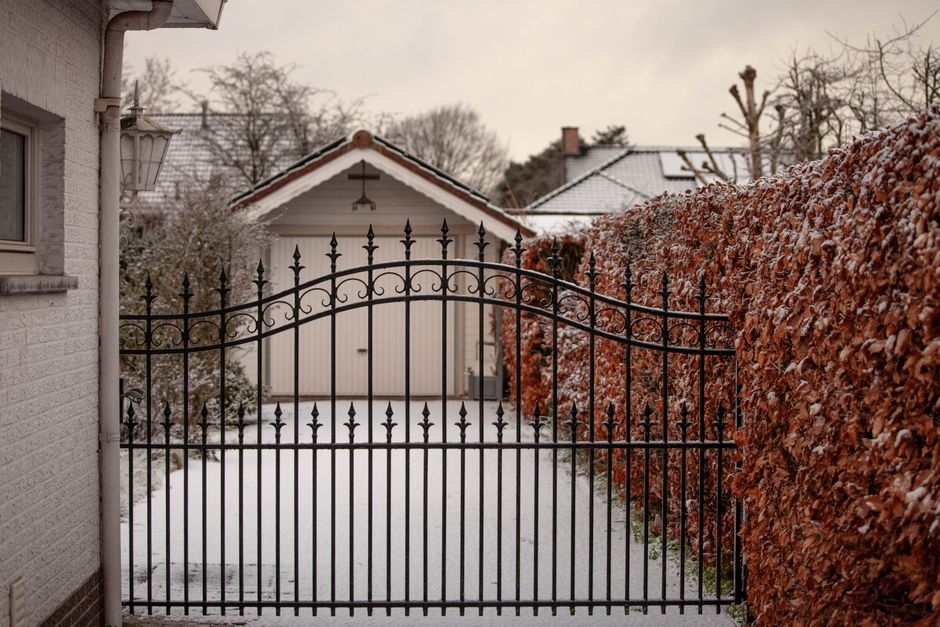
The opening is measured at three heights, not one, because posts and walls are rarely plumb. Take the width at ground level, at waist height and at the height the gate top will sit. The smallest of the three is the clear opening, and the largest tells the fabricator how much trimming the posts may need.
Write down the width between the face of one post and the face of the other, not centre to centre. Add the post size to each side only when the posts are not yet set. A driveway used by a pickup with mirrors, a trailer or a delivery truck needs a wider clear opening than a car, so note the widest vehicle that will pass and leave a hand width on each side of it.
How much room is there beside the opening?
The room beside the opening is the run, and it sets the style. Stretch the tape along the fence line from the edge of the opening and mark where it hits a tree, a meter, a downspout, a corner or a change in grade. If the clear run is shorter than the opening, a slide gate will not fit and a swing gate or a bi-parting layout is the answer.
Check the ground along the run too. Lots near Brushy Creek and Old Settlers Park often have gentle falls toward drainage swales, and the run may drop several inches over its length. A gate on a falling track wants to roll open or shut on its own, so the slope has to be known before the operator is chosen, and a stop or a heavier motor may follow.
What does the slope do to the layout?
Slope changes the choice between a track and a cantilever. A track beam can be poured level in a stepped line, but the steps complicate the roller path. A cantilever carriage ignores the grade between posts, so a driveway that falls toward the street usually leans toward the cantilever style.
Run a string line from the top of one post to the other and drop a level on it. Then measure down from the string to the pavement at each end and at the middle. Those three heights show the grade across the opening, and they tell the fabricator whether the bottom rail needs to follow the ground or clear the high point.
Where do the posts and the footings go?
The posts go where the soil is firm, the utilities are clear and the gate can park fully open without blocking a walkway. Texas requires a locate call before any digging, and the gas, water and electric lines that serve a Round Rock house often run right along the driveway edge, which is exactly where footings are wanted.
Expansive clay soil is the other limit. Footings sit below the layer that swells and shrinks, tie into a continuous beam on a slide gate, and keep water away from the line. Mark every sprinkler head, valve box and downspout outlet within a few feet of the planned beam, because a wet footing moves more than a dry one.
Which side should the gate open toward?
The gate should open toward the side with the most clear run, the least slope and the closest power source. Standing at the street, picture the gate parked open and ask whether it covers a walk light, a house number or an address plaque. Many neighborhoods, including those around Forest Creek, review gate placement for sight lines and setbacks, so note the distance from the curb to the gate line.
A gate that parks inside the property needs a vehicle waiting space outside it. A long driveway apron helps, and a short one may force the gate closer to the house. Measure from the street edge to the planned gate line and from the gate line to the garage door, and write both numbers on the sketch.
What about power and controls?
Power is measured too. The operator needs a supply near the parked-open end of the gate, so measure the distance from that point to the nearest panel or outlet, and note whether the path crosses concrete, a planting bed or a tree root zone. Trenching through a slab is slow and leaves a patch, and routing the conduit before the beam is poured avoids that entirely.
Controls need a place as well. A keypad or intercom stands at a car window height at the entrance, a loop detector wants a clear patch of pavement for the exit side, and a photo eye needs a solid post on each side of the opening. Sketching these points early keeps the wiring plan simple.
What should the sketch show?
The sketch should show every number in one view: opening width at three heights, run length, grade at three points, post locations, utilities, power distance, sprinkler heads, trees and the curb distance. A page with those figures lets a fabricator build the frame, a crew pour the beam and an electrician run the conduit without a second visit to settle basic questions.
Photos help as well. Stand at the street, at the garage and at the end of the fence line and take one picture from each. Add a close shot of anything unusual such as a retaining wall, a stump or a slab joint. Together, the sketch and the photos carry most of what the work needs.
How often do measurements go wrong?
Measurements go wrong most often at the second visit, when a post has been moved, a wall has been added or the ground has been regraded since the first look. A tape reading is a snapshot, and a Round Rock yard changes through a wet spring and a dry summer. Recheck the opening width and the run the day the frame is delivered.
The simplest habit is to measure twice, in different weather if possible, and trust the smaller number. A gate cut too short is a problem, while a gate fitted with a little extra room can be dressed with a post cap or a filler panel and still look right.
Does the measurement change with the gate material?
The material changes the weight and therefore the supports. Steel tubing and wrought iron weigh more than aluminum, so a steel slide gate over a wide opening needs a heavier beam, stiffer carriages and a stronger operator than an aluminum leaf of the same size. Tell the fabricator the intended picket style, because a solid panel catches wind that a picket gate passes through.
Wind matters on open Williamson County lots, where a solid gate acts like a sail. A frame near Interstate 35 or along an exposed ridge may need extra bracing, and the operator should be rated for the extra load on gusty days.
What is the last check before ordering?
The last check is a dry run with stakes and string. Mark the open position and the closed position of the gate on the ground, stretch a string at gate height and walk a vehicle through the opening slowly. If the mirrors clear, the run is long enough and nothing is in the path, the numbers are good.
Only then should the order go to the shop. A frame cut from tubing cannot be stretched, and a few minutes with stakes saves the longer job of reworking a welded leaf.